
Saginaw City Directory Sources by Era
The Saginaw directory record is a regional shelf, not a verified standalone series. Fort Worth and Fort Worth Suburban volumes are the documented leads. A volume can place a Saginaw household in an alphabetic list, a street guide, or a householder section, but inclusion must be checked one volume at a time. The Texas State Library list is a holdings aid, not proof that an item is complete, on site, or broad enough to include a particular Saginaw street. Start with the year closest to the known address, then ask for the exact volume, reel or item and page range.
| Regional collection | Documented years | Where held | Access route |
|---|---|---|---|
| Fort Worth city directories | 1877 through 1989 in listed, discontinuous runs | Texas State Library and Fort Worth History Center | Catalog, physical volumes, or microfilm |
| Fort Worth Suburban directories | 1963–79; 1981–82; 1985; 1987–88; 1990–91; 1993 | Texas State Library and Fort Worth History Center | Verify Saginaw street inclusion first |
| Fort Worth criss-cross volumes | 1930 to present claimed by finding aid | Fort Worth reference collections | Address-to-name lead; exact run needs confirmation |
| Fort Worth Directory | 1916 | Portal to Texas History | Free page images and OCR |
| Tarrant Archives genealogy holdings | Directories, maps, census and related historical material | Tarrant County Archives | Walk-ins Tuesday through Friday; Monday by appointment |
Fort Worth Suburban is the strongest prospect for a Saginaw address, especially in later decades. A criss-cross volume reverses the usual search: begin with a street and number, then read toward a name. That makes it useful when the house is known but the past household is not. Record the title, publisher, year, page, and whether the result came from an image or OCR.
Saginaw Directory Shelves in Fort Worth
Several Fort Worth repositories divide the work. The Fort Worth History Center has more than 40,000 genealogy volumes, 9,500 microfilm units, and 180,000 microfiche, along with newspapers, yearbooks, maps, and directory material. Its genealogy service directs researchers to arrange appointments and check the catalog for offsite items. The Texas State Library lists the regional directory runs. Tarrant Archives supplies maps, regional volumes, school census, cemetery material, probate abstracts, and historic ledgers. These routes are different, so a request should name the collection and the year instead of asking for every record on a family.
The digitized 1916 Fort Worth Directory provides a useful example of a searchable regional volume.
Its item description identifies government, schools, churches, banks, societies, street guides, householders, and alphabetic private-citizen and business entries. It is evidence of a regional directory format, not evidence that every Saginaw household appears in that edition.
Reading a Saginaw City Directory Entry
A city directory entry must be read as a dated printed statement. The 1907–08 Portal sample for Davidson Samuel gives a name, the pursuit “stockraiser,” a civic role, an office location, and a residence notation. The 1916 description confirms that the recurring fields can include a full name, occupation or pursuit, business or residence address, and classified context. A line does not certify ownership, prove a current address, or establish every person in a household. Preserve wording as printed, especially when the line uses an abbreviation.
| Printed name | Use initials, surname order, and spelling exactly as shown before trying variants. |
|---|---|
| Pursuit or role | A dated description that can distinguish people with the same name. |
| Office or business address | A separate location that should not be substituted for a residence. |
| Residence notation | r. marks residence in the documented sample; direction and corner text can be part of the locator. |
| Street wording | Keep house number, compass direction, cross street, and abbreviations for later comparison. |
- Criss-cross directory
- A reverse directory arranged by street and number, used to move from an address toward a named entry.
- Householder section
- A part of a volume that organizes residential or street information differently from the alphabetic name list.
- Abbreviation key
- The volume’s own guide to shortened terms. Photograph or transcribe it before expanding a mark in a research note.
Saginaw Directory OCR Checks
OCR makes a historical volume faster to search, but its output can misread surnames, house numbers, street abbreviations, and faint type. Search a surname with and without an initial, then inspect the scanned page before copying a result. The Portal sample exposes both OCR and a page image, which makes it possible to compare the machine reading with the printed line. Mark uncertain letters in a note rather than silently correcting them. This is especially helpful where a Fort Worth mailing label or a rural description hides a Saginaw connection.
Note: An image-backed transcription is stronger than a bare OCR hit when a name, street number, or abbreviation affects the household trail.
Dido Names in Saginaw Directories
Saginaw’s older place names change the search terms. The settlement was known as Dido before being renamed Saginaw in 1882, and it gained a post office in 1888. Earlier material can therefore use Dido, a railroad or local-place description, a rural route, or a Fort Worth label rather than the city name used today. Three railroads shaped the community in the 1880s, so depot, rail, and nearby place terms can also help an archive search. A missing modern-name hit is a reason to broaden the terms, not proof that a family was absent.
Pair the place variant with the street, subdivision, legal description, or county record date. This geographic context is often more durable than a postal label and keeps a directory result from being attached to the wrong Saginaw household.
Saginaw Directory Timeline Clues
Directory evidence sits inside a longer Tarrant County record history. The sequence below helps explain why a household trail can change sources rather than follow one uninterrupted printed series.
- 1876: A courthouse fire destroyed most early county records, so an empty pre-fire search may reflect loss rather than absence.
- 1877 onward: The Texas State Library finding aid begins its listed Fort Worth directory holdings, with gaps between runs.
- 1882 and 1888: Dido became Saginaw, then received a post office, creating useful name and postal variants.
- 1916: A Fort Worth directory is available as a digitized Portal to Texas History item.
- Later twentieth century: Listed Fort Worth Suburban volumes extend into 1993, but inclusion for each Saginaw address requires verification.
The record sequence also explains a key gap: no official source inspected established a last printed year for a Saginaw-specific directory because no verified standalone Saginaw publisher run was found.
Trace Saginaw Directory Households
A household trace works best when each source answers one narrow question. Directories give an address clue between census releases. Census records give household composition and birthplace context. Recorded deeds test title, while an obituary, cemetery item, or probate file can explain a departure. The public federal census releases for 1900, 1910, 1920, 1930, and 1940 are useful brackets for a directory snapshot. The 1890 schedules were largely destroyed, so no seamless census sequence exists.
- Choose a known address and the closest regional directory year. Capture the exact street spelling, direction, and page.
- Search the alphabetic entries with surname, initials, spouse or relative names, and likely OCR variants.
- Use a criss-cross or street page, when available, to test the address against the name result.
- Pair the directory year with the nearest released census, noting that enumeration geography may differ from current city limits.
- Check the Tarrant Appraisal District legal description and County Clerk deed only when a title question needs confirmation.
- For a disappearance, search the next volume, then use cemetery, obituary, probate, or school-census material as dated endpoint leads.
A name leaving a directory can mean a move, a death, a changed listing practice, a regional coverage gap, or a simple printing error. Log negative searches with the volume and page range. That record prevents a gap from turning into a false family conclusion.
Saginaw Directory Archive Endpoints
When regional directories stop, Tarrant Archives can extend the historical trail with Saginaw cemetery records, school census from 1919 through 1970, marriage volumes, probate abstracts, maps, naturalization material, historic ledgers, and Footprints. Volunteer-derived indexes are finding aids, so the underlying image or original volume remains the item to verify. The Fort Worth History Center adds newspapers, yearbooks, maps, census material, and onsite databases. NARA at Fort Worth is another route for federal census, naturalization, military, passenger, and microfilm resources by appointment.
The Tarrant Archives genealogy holdings show the range of material that can close a Saginaw directory lead.
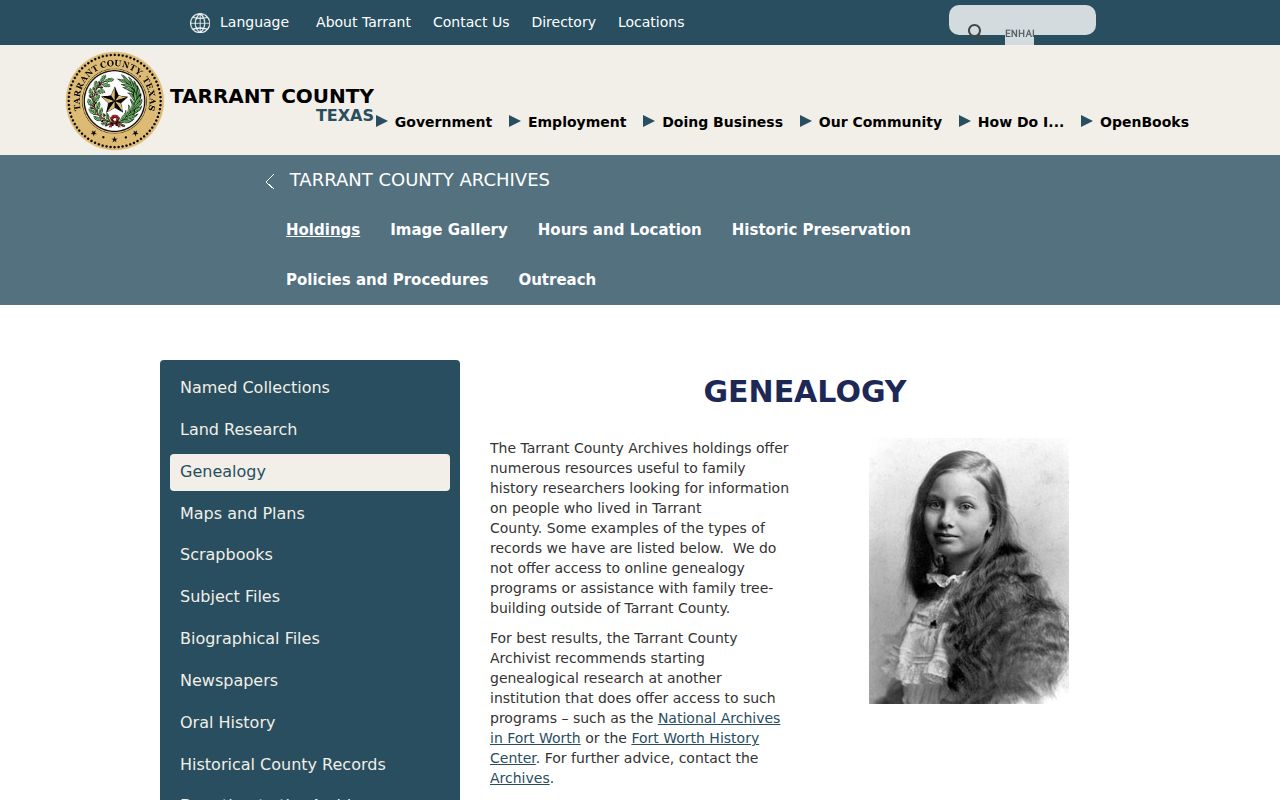
The archive image belongs in a source chain beside the directory title, page, and date. It does not convert a cemetery, school, or probate reference into proof of the same person without matching names, dates, and other records.
Saginaw Directory Limits
Regional directories are snapshots. They may omit a street, use a Fort Worth label, reflect a late move, or list a business rather than a home. The local criss-cross finding aid claims a run from 1930 to present, but the exact physical volumes and current stopping year still need confirmation. No official Saginaw obituary-index title, funeral archive, church-register collection, or standalone city-directory run was verified in the inspected sources. Ask a repository about a specific volume or record group and keep the uncertainty in the result.
For current address-keyed ownership work, use the Saginaw street directory route rather than treating an old printed entry as a present-day record. A dated directory entry is most useful when its year, page, regional coverage, and original wording travel with the finding.